Sunday, March 29, 2009

More D & F


Back in November, I blogged about the upcoming Centennial of the Daniels and Fisher Tower. You can link back to that blog here. While doing other research however on another project, I came across this fun advertisement from the December 10th, 1910 edition of Denver Municipal Facts. The caption for the above advertisement reads, "The New Store and Tower of the Daniels and Fisher Stores Company at Sixteenth and Arapahoe Streets as It Will Appear When Completed." I especially like the drawing of so many transportation choices in 1910: walking, bicycle, horse, horse and carriage, street car....and that new thing called an automobile.

Hopefully you'll be able to read the type script when you click on the picture. I couldn't get it any larger without sacrificing some of the image itself.

Monday, March 9, 2009

A Glorious Day for Denver: June 24, 1872


I recently had the honor to speak at the Denver 150 Symposium, "Denver Indside and Out". Numerous subjects were discussed concerning early Denver and its growth over the past 150 years. I spoke about the struggle to build the city's first school building which was eventually known as the Arapahoe School. The picture above shows the cornerstone laying ceremony from June 24, 1872 when most of the whole town turned out for a huge celebration. The picture gives me chills when I imagine all of those people, horses and carriages gathering to celebrate the establishment of our modern school system in Denver. The fights and struggles over how the building would be funded contributed greatly to its delay in actually being built (arguments that sound just like the FasTracks discussion in Denver today). But the party atmosphere shown above was captured in this passage from the Rocky Mountain News, June 25, 1872:

…the procession probably contained not less than two thousand persons while the number of spectators who thronged the streets could not have been less than six thousand. Windows, sidewalks and every available spot on the line of the march, especially through F [15th] Street, were occupied…..an immense throng of spectators filled the space about the school building. A crowd of men and women roosted themselves upon the observatory of Tritch’s elegant mansion, where beneath the blazing sun, they endeavored…to be jolly, but were really very miserable.

What's this town you say? Well, lo and behold, the first Denver skyline. Public School One, later known as Arapahoe School (but almost called Anderson School) sits as the tallest building in Denver. For many years, visitors to Denver travelled to 17th and Arapahoe to go to the school's cupola for stunning views of the city down below. This picture above is taken from near 15th and the Platte River, not far from where the REI store is today. The school was officially ready for use on April 2, 1873. When it opened for primary grades, it was the largest school in Colorado Territory.

The beautiful Arapahoe School, designed by Chicago architect G.P. Randal, eventually contained the first high school classes in Denver and Colorado, starting in 1874. The Class of 1877 was the first to graduate from the school and included Irving Hale who went on to be a Brigadier General during the Spanish-American War. If you've heard of Hale Parkway in east Denver, it is named in his honor. This pictures shows the Henry Rietze House on the left and the Thomas M. Field House on the right.

This photo, circa 1879, shows the German Methodist Episcopal Church, looking from the corner of 18th and Arapahoe. The high school eventually left Arapahoe School when the new Denver High School was opened at 1932 Stout in 1882. This school became known as East High School.

The top photo is taken from the observation deck of the school. It shows a view looking east with a bit of the First Baptist Church under construction at 18th and Curtis. It is especially interesting to see the large home across the road complete with a fountain! The second photo is looking northwest toward Boulder. The Ezra A. Newton residence is on the left. The school was a big tourist attraction. When US Vice President Henry Wilson visited Denver in 1875, he stopped by and made an address to the high school students.


But of course, in Denver, nothing seems to last. The explosive growth experienced by the city after the arrival of the railroad in 1870 endangered the lovely old school building. By 1890, it was in the middle of a business district and people were clamoring for its closure and removal to a more suburban location. The district complied and sold the land and building. The Club Building, designed by Frank Edbrooke of Brown Palace fame, was built in front of the school. The old school acted as a back annex for the lovely Club Building. Above is a photo circa 1910.


This photo is circa 1893 and shows a tiny sliver of the Arapahoe School on the right behind the Club Building.


Even the Club Building could not survive the onslaught of the automobile. It, like numerous buildings in downtown Denver, was demolished in 1955 to make way for an expansion of the Federal Reserve Building (which was soon to be demolished too) and also for a parking lot! The photo above was taken from the alley and is the last known image of the Arapahoe School. Construction workers are lowering a wheelbarrow. The Denver Post reported that "no one even noticed or cared" that the old school was coming down. That is not true, but...that is a whole other story. Today, portions of Skyline Park takes up the space where the Arapahoe School once stood.


For additional information on Block 077, home of the Skyline Park and the old Arapahoe School, click here to be taken to DenverInfill.com


All black and white historic photos are from the Denver Public Library's Western History Collection.


Sunday, February 1, 2009

17th and California


One of my hobbies includes looking for old pictures, papers and other ephemera associated with old Denver. A couple of years ago, I purchased a souvenir book called Denver by Pen and Picture. It dates from 1898 and has some wonderful pictures of buildings long gone from our memory and others more recently lost. The picture above actually has a couple of buildings that are still around.

The large prominent white building in the center of the picture is none other than the Equitable Building (1892) which still stands at the southeast corner of 17th and Stout. If you haven't been in the vestibule and inner lobbies of this building, you owe it to yourself to step inside and explore.

Across from the Equitable Building on the northeast corner of 17th and Stout stands a four story building known as the Albany Hotel (1885). This structure stuck around until 1977! What forces were in place to take this building down...I don't know. More research. I was only in kindergarten then. I do know it probably has something to do with the skyscraper in place today, the Johns Manville Plaza building. I just wonder if there was any move to save the Albany.

On the far left, along California Street at 16th, stands a dark brick building which still stands today, although you will not recognize it in this picture. The Hayden, Dickinson and Feldhauser Building (1891) underwent an Art Deco transformation in 1937 and was renamed the Colorado Building.

Frank Edbrooke's California Building (1892) stands at the southwest corner of 17th and California. I'm guessing it came down just prior to its replacement--the 1962 Formalist wonder known as Western Federal Savings. This was one of Denver's early skyscrapers and it still stands, although some of its Formalist elements have been removed. This linked picture from DenverInfill.com also shows the Equitable Building at the rear.


Appropriately, in the photo above, on the southeast corner of 17th and California, stands the Nevada Building. It is visible also at the photo at the top of this blog. It was replaced eventually by the Security Building, circa 1920.

Most intriguing I find are the homes, both large and small on the northwest corner of 17th and California, along with the carriages. The corner home is large and prominent and definitely a symbol for the past by 1898, as its days were numbered. Homes are also visible along Welton Street in the foreground. It is no surprise that Trinity Methodist Church would locate itself at 18th and Broadway in 1888 to take advantage of all of the people who lived nearby. This was a short-lived residential area however. The growing city along with the coming of the automobile forever changed the residential character of the downtown we know today. Incidentally, I haven't yet figured out who lived in the large home at this corner. I do know that by 1912, the house, if still standing or not, had a new neighbor across the street (on the northeast corner) in the form of the International Trust Company Building. It was torn down in 1974 and remains a plaza today.

This blog covers a number of blocks and buildings at the intersection of 17th and California. Click here to go to DenverInfill.com to learn more about the modern city present today at this location.

The top photo, as I stated, is from my private collection. The second photo is from the Denver Public Library's Western History Collection.

SPECIAL NOTE: I am currently looking for personal pictures from City Park, Whittier and the Capitol Hill areas of Denver for another research project I'm involved in. My time period of interest is prior to 1950. If you know of any personal collections of such items, please email me directly at shawn@denverhistorytours.com

Monday, December 22, 2008

The Denver Club and Glenarm Place


The picture above illustrates the continuing changes that have befallen downtown Denver, both good and bad. It is difficult to believe but this is the SW corner of 17th and Glenarm, circa 1889. We know that change is constant but sometimes it is heartbreaking to see all that Denver has lost over the years with the onslaught of new development and parking lots. The two buildings shown include the First Congregational Church of Denver (1880) and the Denver Club Building (1889).


First Congregational had relocated to the "suburbs", leaving its home of many years near 15th and Curtis and building a new edifice on Glenarm Place for $41,000 in 1880. It was alone on a block that was otherwise filled with homes of everyday Denverites.


This picture, circa 1888, shows the Denver Club Building under construction. Taken from the Arapahoe County Courthouse (1883), notice the numerous single family homes that populate Glenarm Place, 16th Street and adjacent areas.


This picture, circa 1889, shows the newly completed Denver Club and a very smoggy city! Take note of the new Denver High School (1881) on the far right at 19th and Stout.


By 1891, the two buildings had a new neighbor on Glenarm Place. The destruction of the houses of the area continued as the Kittredge Building (1891) joined the neighborhood.


This picture shows the Kittredge Building under construction. We are lucky to still have this lovely building grace the corner of 16th and Glenarm. The other two buildings were not so lucky. Click here to see a current picture of the block taken from 16th Street. Although we certainly appreciate and love the Paramount Theater, it was built on First Congregational's site in 1930. The old Denver Club Building suffered a different fate. In 1954, it was replaced by the new Denver Club Building--a skyscraper. Along with the Mile High Building, it was one of the first modernist buildings constucted in Denver and therefore today, is in and of itself a Denver landmark. Modern sentiment however laments the loss of yet another Victorian building in the old Denver Club. Will the "new" Denver Club suffer the same fate? Unlikely, as it is part of downtown Denver's historic buildings district.


For additional information on Block 174, home of the Denver Club Building, click here to be taken to DenverInfill.com

All black and white historic photos are from the Denver Public Library's Western History Collection.

Sunday, November 16, 2008

The Daniels and Fisher Tower


We are just a few years away from the centennial of one of Denver's most iconic buildings. The Daniels and Fisher Tower at 16th and Arapahoe Streets opened to the public in early 1912 but began construction in 1910. Modeled after the Campanile in Venice, Italy, the building was the tallest structure west of the Mississippi River upon completion. It was designed by the architecture firm of Sterner and Williamson. The hour hand is eight feet long and the minute hand is 6 feet long--designed by the Seth Thomas Clock Company. Its construction marked a new era not only in Denver's retail scene but in its architecture. Daniels and Fisher was the department store of choice in Denver until it merged with the May Company in 1957. The building was soon abandoned for new digs in the newly created May D&F Department Store located at Zeckendorf Plaza at 16th and Court Place.

The Daniels and Fisher Department Store had its roots in the very beginnings of Denver; the tower epitomizes the quick growth of Denver, having been constructed just shortly after the city celebrated its 50th birthday. William B. Daniels started his store in 1864 on Larimer Street. He was later joined by William Fisher in 1872 to form Daniels and Fisher. Daniels son, William Cooke Daniels, took over the helm in 1891.

The tower's beauty was under-appreciated as the decade of the 1960's began and with the Skyline Urban Renewal Project in full swing, the old department store's days were numbered. Miraculously, the tower was saved but the rest of the department store was gone by 1971. The red brick scar on one side of the tower shows where it used to be attached to the rest of the department store. The year 1971 was a big year in preservation awareness in Denver as the battle lines were drawn. Some successes included the continued preservation of Larimer Square and saving the Molly Brown House. But other battles were lost, including the loss of the Moffat Mansion at the northeast corner of 8th and Grant.

The comic below shows the complacency of most of Denver during this time and how close we came to losing the D & F Tower as well. Even though this comic was drawn in 1965, it was not enough to provoke the city into changing course on preservation. We might have been able to have had a few more preservation success stories such as saving the Tabor Grand Opera House, knocked down in 1965, but the planets did not align. Perhaps if the successful State Historic Fund had been present in those years, more money would have been available to shore up and preserve other structures long forgotten and since demolished but certainly worthy of being left for posterity!


The top photo is from the Denver Public Library's Western History Collection. The editorial cartoon was created by Pat Oliphant of the Denver Post.

Post Script: For regular readers, I apologize for delays in posting. If I had eight hands, it would be better! However, the past months have been extremely busy and therefore, successful, in the walking and bus tour business, especially as related to Haunted Denver!!!

Monday, September 1, 2008

City Park Fountain


Now that the DNC is over, we can thankfully look back on a very successful and historic convention for Denver. The city looked wonderful and conventioneers were treated to Denver at its best. While museums and other cultural attractions (including my work place) were not as busy as was projected, hopefully all visitors left Denver feeling they had come to a special place. For those who were able to venture out to City Park, a truly historic treat awaited them. Refurbished just in time for the 2008 Democratic Convention was the City Park Fountain. If you were unaware of there being a fountain at City Park, you're not alone. It has been out of commission for years. But it was originally put in place for the 1908 Democratic Convention. Read more about its rebirth here via the Denver Post.

City Park continues to bring joy to Denverites of all ages. Luckily, the city was able to eradicate the ugly green sludge that was plaguing Ferril Lake this summer. In the middle of this lake, named for Thomas Hornsby Ferril (Colorado's poet laureate and native Denverite who passed away in 1988), sits the fountain. The City Park Pavilion provides a dramatic backdrop as does the Denver skyline beyond.


While I've been busy with the convention, frequent blog visitor Bruce Quackenbush kindly provided historic post card images of the original fountain (below) as well as current photos from its recent re-unveiling, as seen above. I usually focus on changes to downtown Denver's built environment. However, I am not opposed to covering other areas of the city. And the historic fountain is certainly pertinent to this blog. If you haven't been out to see it yet, get there soon. It goes dark at the end of September. It will return to delight City Park visitors next May 2009.


This view shows the old portion of the then Colorado Museum of Natural History on the upper left side. The word Colorado was replaced by Denver about 1948. Today, after many additions, it is known as the Denver Museum of Nature and Science


As always, I appreciate all of the kind comments and blog suggestions that I receive. Thank you for reading.

Wednesday, July 23, 2008

Larimer Square


Larimer Street circa 1960


Larimer Street, circa 2008
(photo courtesy Denver History Tours, 2008)


It was called the Skyline Urban Renewal Project. What most politicians and elected officials celebrated as "progress as promised" back in the 1960s, was viewed with skepticism by regular Denverites. The successful proposal flattened most of Denver's historic core for new structures, using Federal dollars, and therefore bypassing any need for the use of local tax money. The result was a shiny new downtown we enjoy today. But much was lost. The heartache historians feel is somewhat tempered by what we managed to save. The fight to save even one block was a monumental task which required vision and foresight. Such vision was necessary in order to see past the blighted building exteriors and see a vibrant urban setting consisting of some of the city's earliest structures (see comparisons above between 1960 and 2008). What we know today as Larimer Square was the result of one woman's tenacity and therefore, we thank Dana Crawford for her efforts. Still, if only we could have saved more. We only have pictures to remind us of our past, but if economics and politics had been different back in the 1960s and 1970s, our downtown would look much different today. Larimer Square was a big gamble and really marked an awakening in Denver for historic preservation. The area was declared Colorado's first historic district back in 1971. While we celebrate Larimer Square, few realize the tremendous built environment that was lost, not only on Larimer Street, but throughout downtown. It's no coincidence that one can find old buildings north of 20th Street, similar to those in the 1400 block of Larimer. The urban renewal line stretched up to that street. It's taken 40 years, but today, even those buildings north or 20th are starting to be renovated. Let's take a look back at a few pictures of the old "Larimer Square", to understand the difficult proposition faced at that time of saving even one block of this 'derelict' street.


This picture, circa 1960, shows that Larimer Street was suffereing the effects of urban neglect as those who could continued to depopulate downtown. Larimer was by this time, a collection of "eclecticism", or as others saw it, a kind of skid row, full of bars, porno shops, vice, drugs, pawn shops, and second or third tier retail. When urban renewal tried to erase this urban neighborhood, much of this "vice" moved to East Colfax Avenue.


Most of the structures on Larimer date from the 1880s and 1890s, other than the modern structures which have filled in the gaps. Can you find the modern buildings today? Two of the most interesting buildings on the street are the stunning Second Empire style Lincoln Hall, and the oldest structure on the street, the 1873 Gallup-Stanbury Building. Both are seen below:


A Victorian style of archicture, known as Second Empire, is exhibited at Lincoln Hall. This style, once more prevalent downtown, is now quite rare in Denver. (photo courtesy Denver History Tours, 2008)


Who knew that The Market is housed in the oldest structure in Larimer Square? (photo courtesy Denver History Tours, 2008)


The splendid 1882 Granite Building, also known as the Clayton Building for its builders. This picture is circa 1950. This building once housed the McNamara Drygoods Company, the predecessor to the Denver Drygoods Company.


This shows the same structure circa 1970. Notice the occupant of the lowest level. The Flick is assumed to be an adult movie house. This building sits on the site of William Larimer's first cabin in Denver. He founded the city on November 22, 1858. (Photo Credit: Brettell, Richard R. Historic Denver: 1858-1893, Denver, p. 204.)


A True Survivor: The Granite Building, circa 2008
(photo courtesy Denver History Tours, 2008)


This photo, circa 1960, is quite a jewel. It shows the 1600 Block of Larimer. To see the same block today, click here. Imagine if all of Larimer Street had been preserved! This would be some of the hottest property downtown today. One piece from this photo survives however. Take a look at the Manhattan Restaurant at 1633 Larimer. In front of it is a cherub statue, which welcomes visitors to Denver. For reasons unknown, this little remnant was preserved.


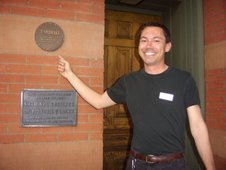
Located in the Courtyard of the Bear and the Bull in the rear of the Kettle Arcade on Larimer Square, we can revel in one piece of Denver's past, still welcoming all to the city. That smiling gentleman is the owner of Denver History Tours--Kevin Pharris!
(photo courtesy of Denver History Tours, 2008)

To learn more about the history of the individual buildings on Larimer Square, click here.

I generally concentrate on one block or the side of one block to coordinate best with DenverInfill.com However, for the purposes of Larimer Square's history, this current blog used the east side of Block 45 and the west side of Block 70. Click to learn more about the current state of these blocks at DenverInfill.com

Unless stated otherwise, all historic photos are from the Denver Public Library's Western History Collection.

UPDATE: Many of you have written in concerning the The Flick movie theater located in Granite Building during the 1960s. I had assumed it might be an adult movie house because the picture I have appears to show drawings of scantily clad women in its windows. However, the consensus seems to be that The Flick was an artsy type movie house. It sounds like it was the Mayan Theater of the day. Therefore, we will err on the side of those who were actually there at The Flick! However, newspaper ads from this era do indeed show that there were numerous adult movie houses not only in the areas of lower downtown but upper downtown as well.